
Not ready to buy a house yet? GOOD. Read This.
Want to Buy a House Someday? Do These 5 Things Now
Jenny Jones, The Jones Team at Baird & Warner | 10 min read | Last reviewed: September 2026

The Short Version
If you’d like to buy a home someday, you don’t need to start house hunting tomorrow.
Instead:
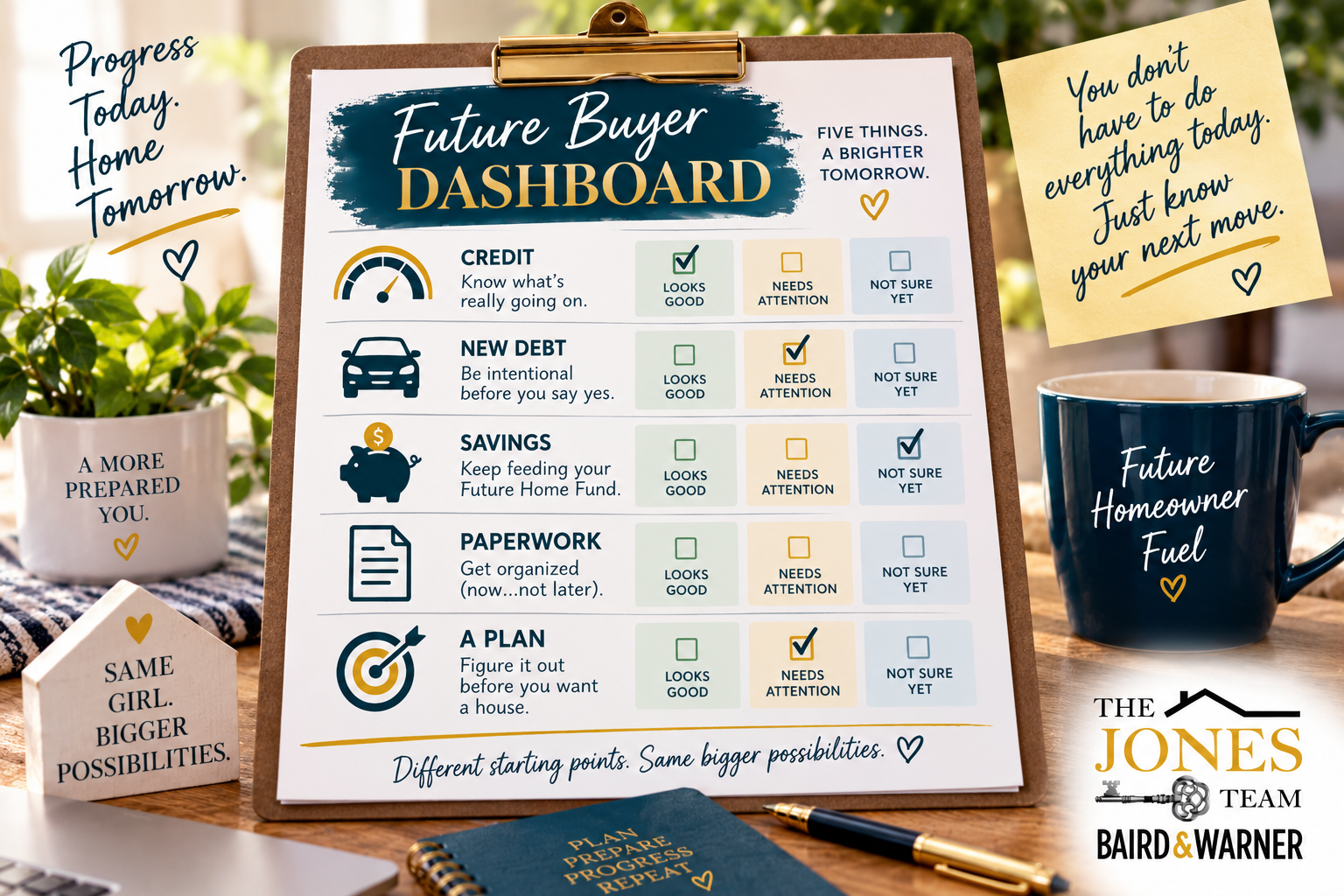
1Know what’s happening with your credit.
2Be intentional about taking on new debt.
3Keep building your Future Home Fund.
4Get your financial paperwork organized.
5Make a plan before you actually want a house.
And here’s the really important part:
You do NOT need to tackle all five at once.
Your job right now is simply figuring out which one deserves your attention first.
There’s actually a HUGE advantage to not being ready to buy a house yet.
You have time.
Time to save.
Time to clean a few things up.
Time to make smart decisions instead of rushed ones.
And time to figure out what actually needs your attention before you fall in love with a house and suddenly want the keys by Tuesday.
Because the worst time to start making a home-buying plan is when you’ve already found the house.
If owning a home is somewhere in your future—even if that future is still a little fuzzy—there are a few things you can start doing now that can make Future You’s life a whole lot easier.
And no, this is not a 47-step homework assignment.
We’re going to keep it to five.
1Know What’s Actually Happening With Your Credit
Notice I did not say:
GET A PERFECT CREDIT SCORE IMMEDIATELY.
We’ve already kicked that myth to the curb.
There isn’t one magical credit score that determines whether you’re allowed into the Homeownership Club.
Different mortgage programs and lenders have different requirements.
But if buying is somewhere in your future, you should know what’s actually on your credit reports.
The Consumer Financial Protection Bureau recommends reviewing your credit reports early in the home-buying process so you have time to spot mistakes and address them before you’re shopping for a mortgage. Checking your own credit also doesn’t hurt your credit scores.
Look for things like:
◆accounts you don’t recognize
◆incorrect balances or payment information
◆old information that may be inaccurate
◆anything else that makes you say, “Well THAT’S interesting.”
You don’t need to obsessively stare at your credit score every morning while drinking coffee.
You just don’t want your first serious look at your credit to happen when you’re already trying to buy a house.
Want the deeper dive? Read What Credit Score Do You REALLY Need?
2Think Before You Take On New Debt
This one needs a giant asterisk.
I’m not telling you that because you might buy a house someday, you must stop living your life.
But new monthly debt can affect the amount of mortgage payment your finances can comfortably support. Lenders look at existing obligations such as auto loans, student loans and credit-card debt when evaluating your overall financial picture.
So before taking on a shiny new payment, ask yourself:
Do I need this—and does it still make sense with my future home goal?
Sometimes the answer is absolutely yes.
Sometimes it’s:
Maybe I don’t need the $900 car payment and the panoramic roof quite that badly.
The goal isn’t financial perfection.
It’s awareness.
Today’s payment may still be sitting at the table when Future You wants a mortgage.
3Keep Feeding Your Future Home Fund
Remember that Future Home savings bucket we created?
Keep going.
You do not need to magically stuff it with $20,000 by next Thursday.
Maybe it’s:
Whatever works for your actual life.
At this stage, the habit matters.
Because buying a house involves more than a down payment. There can also be closing costs, moving expenses, initial home expenses and money you’ll want to keep available instead of draining every dollar at closing. CFPB guidance specifically recommends considering those additional costs and keeping a financial cushion when determining how much cash you can use toward a purchase.
Your Future Home Fund isn’t just:
“Money for my down payment.”
It’s:
“Money that gives Future Me options.”
And options are lovely.
If you haven’t already read it, The Money You ACTUALLY Need to Buy a House breaks down the different jobs your home-buying money may need to do.
4Get Your Financial Paperwork Organized
This one isn’t glamorous.
There will be no HGTV special called Hot Bank Statements.
But when you eventually apply for a mortgage, lenders are going to ask for documentation.
Common examples can include recent pay stubs, W-2s, tax returns, bank statements, documentation of other income and information showing where your down-payment funds came from. Exactly what’s required can vary depending on your lender, loan program and financial situation.
If you’re self-employed or have irregular or nonwage income, additional documentation may also be needed.
You do not need to build a pristine mortgage application packet today.
But you should probably know where your financial documents live.
And this is especially useful if your finances have a story attached to them.
Maybe you:
◆changed jobs.
◆have a side hustle.
◆are self-employed.
◆receive irregular income.
◆have money spread across several accounts.
◆expect gift funds from family.
None of those things automatically mean PROBLEM.
They may simply mean DOCUMENTATION.
Future You would probably prefer not to conduct an archaeological dig through seven email accounts, three laptops and a filing cabinet last opened during the Obama administration.
Get organized now.
You’ll thank yourself later.
5Make a Plan BEFORE You Actually Want a House
This might be the most important one.
A lot of future buyers imagine the process like this:
Except...
that’s backwards.
A much better version is:
The CFPB’s home-buying roadmap follows a similar progression: before serious home and mortgage shopping, consumers are encouraged to review credit, understand spending, consider affordability and gather financial paperwork.
That doesn’t make buying a house less exciting.
It makes you better prepared when it finally is exciting.
Instead of wondering:
“Can I buy this?”
you’re much closer to knowing:
“Here’s what works for me.”
That is a very different position to be in.
BUT WHICH ONE SHOULD YOU WORK ON FIRST?
This is where people get tripped up.
They start researching homeownership and suddenly the internet starts screaming:
And your brain responds:
Excellent. We shall do none of it.
You don’t need five simultaneous financial improvement projects.
You need to figure out which area currently deserves the most attention.
Maybe your credit looks pretty good, but you haven’t saved much yet.
Great.
Your Future Home Fund gets the attention.
Maybe you’ve saved consistently, but your credit report has some things you don’t understand.
Start there.
Maybe the finances aren’t actually the biggest question at all.
Maybe you simply don’t know when, where or what you’d eventually want to buy.
Then your first step may simply be creating a loose plan.
Different future buyers need different things.
That’s normal.
WHAT THIS DOESN’T MEAN
Preparing to buy a home does not mean you need to:
✗have perfect credit
✗eliminate every dollar of debt
✗save 20% for a down payment
✗gather every mortgage document immediately
✗know exactly when you’re buying
✗get preapproved tomorrow
✗start scrolling listings until 1:00 a.m.
✗tour houses this weekend
Preparation and readiness are not the same thing.
You can prepare for homeownership long before you’re ready to buy a home.
In fact, that’s kind of the point.
YOUR ONE THING
Time needed: approximately 30 seconds
Pick the ONE area that needs the most attention—and start there.
Which one is yours?
Don’t choose three.
Don’t build yourself a color-coded 19-tab spreadsheet unless that brings you joy.
Pick ONE. That’s your job right now.

Because:
You don’t have to do everything today. Just know your next move.
SO...WHEN SHOULD YOU ACTUALLY TALK TO SOMEONE?
This is where we’re going to make an important distinction.
You don’t have to be ready to buy a house before you’re allowed to ask questions about buying one.
There’s a stage between:
and
“LET’S GO BUY ONE.”That middle stage is where you start figuring out what your path might actually look like.
Maybe you’re six months away.
Maybe you’re eighteen months away.
Maybe you have absolutely no idea.
That’s okay.
The goal right now isn’t to force a timeline.
It’s to stop treating homeownership like some giant mystery you’ll figure out later.
And if you’re not sure which of these five things deserves your attention first?
That’s a perfectly good question to ask.

The Jones Team can help you think through what your next step might be—even if buying is still down the road.
Because you’re not trying to become a home buyer today.
You’re becoming a more prepared future homeowner.
And that’s exactly where you’re supposed to be.
Explore the Future Homeowner Plan →FREQUENTLY ASKED QUESTIONS
How early should I start preparing to buy a house?
There’s no universal timeline. Starting earlier simply gives you more time to understand your credit, build savings, evaluate debt, organize documents and make decisions without rushing. CFPB guidance recommends working through financial preparation before serious mortgage and home shopping begins.
Do I need to pay off all my debt before buying a home?
No. Having debt does not automatically prevent you from getting a mortgage. Existing monthly obligations are part of the overall financial picture lenders evaluate, so understanding your debt—and being thoughtful about adding more—can help you prepare.
Should I avoid opening new credit before buying?
If you’re approaching the time when you’ll apply for a mortgage, be particularly thoughtful about new debt and credit decisions. Your credit history, scores and existing monthly obligations can affect mortgage qualification, pricing and affordability.
What documents will I eventually need for a mortgage?
Common documents can include pay stubs, W-2s, tax returns, bank statements, information about other income and documentation showing the source of funds you’ll use toward the purchase. Requirements vary based on the lender, loan and borrower.
Should I get preapproved if I’m not ready to buy yet?
Not necessarily. If you’re still in the early preparation stage, it can make more sense to understand your finances, credit, savings and timeline first. Once you’re closer to seriously shopping, you can move into exploring mortgage options and talking with lenders. The CFPB similarly separates the financial-preparation stage from the later mortgage-shopping stage.
What if I don’t know which of the five things I need to work on?
Then that’s your next step.
You don’t need to diagnose your entire financial life by yourself. A conversation with the right professional can help you understand what information you need and what questions may be worth asking next—without committing you to buying a house tomorrow.
Keep going in the Future Homeowner Plan
◆ WAIT. Who Told You That You Need 20% Down?
◆ What Credit Score Do You REALLY Need?
A Quick Note Before You Go
Mortgage requirements vary by borrower, lender and loan program. This article is general educational information and isn’t financial, credit, legal or lending advice. When you’re ready for advice about your specific financial situation or mortgage options, talk with an appropriately qualified financial, credit or mortgage professional.
About Jenny Jones & The Jones Team
Jenny Jones and The Jones Team Realtors at Baird & Warner help buyers throughout Chicago’s northwest suburbs understand the home-buying process before they’re standing in someone’s beautifully remodeled kitchen trying to make a six-figure decision because they really like the backsplash.
With more than two decades of real estate experience, Jenny believes educated buyers make better decisions—and that you shouldn’t have to already be ready to buy a house before you’re allowed to start learning how to become ready.
The Future Homeowner Plan was created for exactly that reason:
Small steps now. Bigger possibilities later.
Sources
Consumer Financial Protection Bureau — Preparing to Shop for Your Mortgage
Consumer Financial Protection Bureau — Get Your Money Situation in Order
Consumer Financial Protection Bureau — Figure Out How Much You Want to Spend
Consumer Financial Protection Bureau — Determine Your Down Payment
Consumer Financial Protection Bureau — Create a Loan Application Packet
Last reviewed: September 9, 2026
Categories
Recent Posts









It's EASIER to Move When The Jones Team Has Your Back!
+1(224) 622-3237 | jones.team@bairdwarner.com