
You're Already Paying Rent...Why Not Make it COUNT?!
Your Rent Could Actually Help Your Credit
By Jenny Jones, The Jones Team at Baird & Warner | Reading time: about 6 minutes | Last reviewed: September 2026

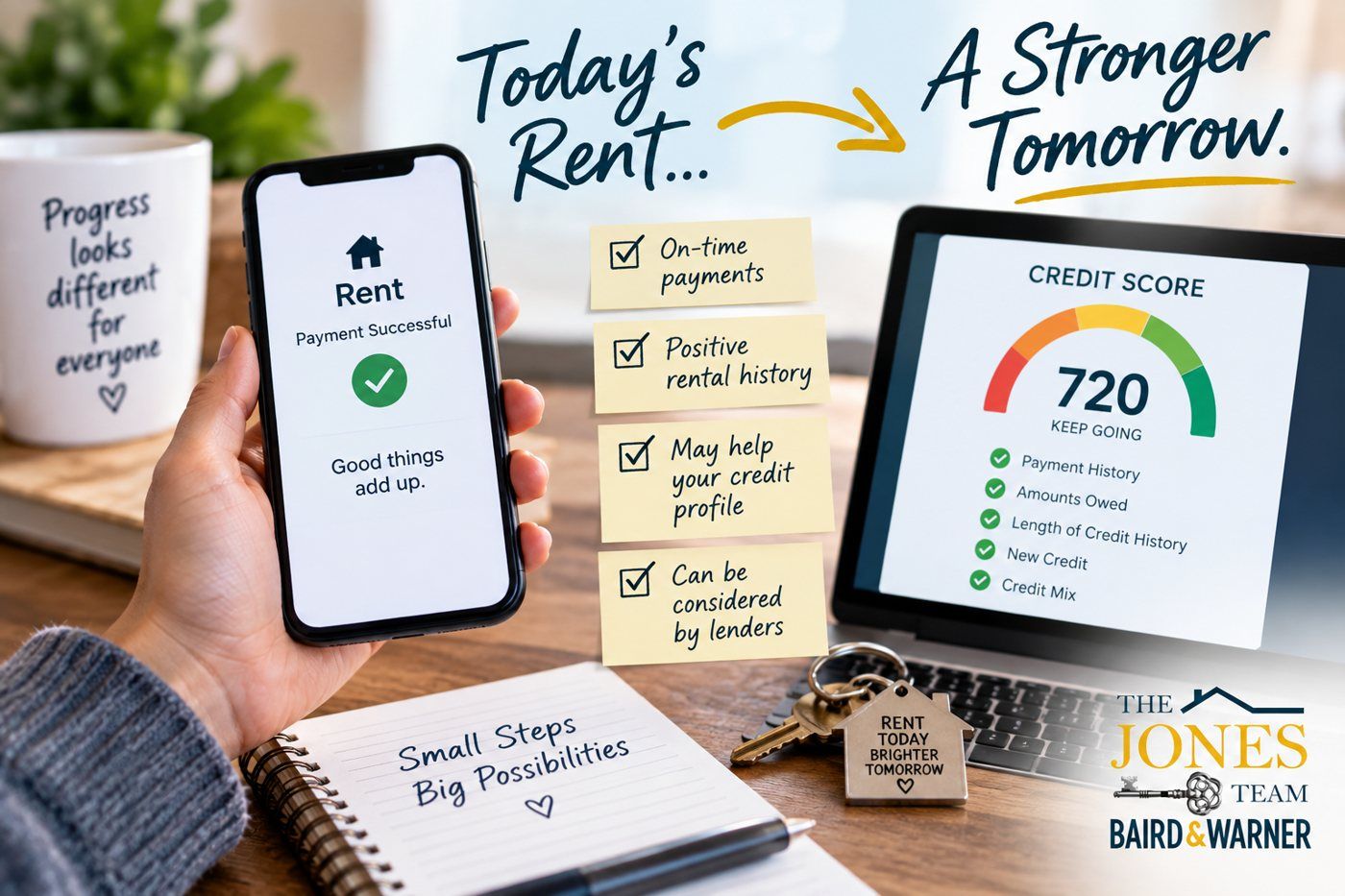
Paying rent doesn’t automatically build your credit. But if your on-time rent payments are reported, that history may become part of your credit profile—and rental payment history can also matter in certain mortgage underwriting situations.
The takeaway isn’t “report your rent and magically qualify for a mortgage.” It’s “you’re already paying rent—find out whether those payments could be doing more for you.”
You pay your rent every month.
Maybe it’s $1,500. Maybe it’s $2,000. Maybe it’s an amount that makes you look at your bank account and mutter something inappropriate under your breath.
Either way, it’s probably one of the largest bills you pay every single month.
So you’d think somebody would at least give you credit for it.
Literally.
Here’s the weird part:
Paying Your Rent Doesn’t Automatically Build Your Credit
You can pay your rent on time, every month, for years and those payments may never appear on your traditional credit reports.
Why?
Because unlike a credit card or car loan, your landlord generally isn’t automatically reporting your monthly rent payments to the credit bureaus.
Which means you could be proving month after month that you can responsibly handle a pretty substantial housing payment…
…and your credit report may have absolutely no idea.
Rude.

But there’s some good news.
You May Be Able to Get Your Rent Reported
There are programs that allow eligible rental payments to be reported to one or more of the major credit bureaus.
Sometimes your landlord or property management company already participates in one.
Sometimes you can enroll in a rent-reporting service yourself.
And some services may even be able to verify previous rental payments and add eligible payment history.
Once reported, rental history can be considered by certain newer credit-scoring models.
Does that mean reporting your rent will magically send your credit score through the roof?
No.
And anybody promising you that deserves a suspicious side-eye.
Credit scores are calculated using a whole bunch of information, and the effect of adding rental history will depend on your individual credit profile and the scoring model being used.
But for some renters—especially people with a limited or “thin” credit history—adding a record of consistent, on-time housing payments may help strengthen their overall credit profile.
And considering you’re already making those payments anyway?
It’s certainly worth knowing whether they’re getting any credit for it.
Start With One Very Simple Question
Before you sign up for anything, ask your landlord or property manager:
You may discover they’re already participating in a rent-reporting program.
If they aren’t, ask whether one is available.
Then check your own credit reports to see what is actually being reported.
You can currently access your reports from all three major credit bureaus for free through AnnualCreditReport.com.
Look for your rental information and make sure anything being reported is accurate.
If your rent isn’t showing up, you can investigate rent-reporting services available directly to renters.
Just don’t automatically sign up for the first shiny thing Google serves you.
Know What You’re Signing Up For
Rent-reporting programs aren’t all the same.
- ◆Some may report to all three major credit bureaus. Others may report to only one or two.
- ◆Some are free. Others charge enrollment or monthly fees.
- ◆And you’ll want to understand exactly what rental information gets reported.
This part matters.
If your rental history hasn’t exactly been a flawless display of punctuality, find out whether a service reports only positive payment history or also reports late or missed payments before enrolling.
In other words:
Know what’s inside the box before you enthusiastically dump the box onto your credit report.
Future You will appreciate the due diligence.
Where People Get Tripped Up
Five things renters tell me all the time. Here’s why each one isn’t quite right.
Rent reporting is not:
- ✗a guaranteed credit-score increase
- ✗a credit-repair shortcut
- ✗a replacement for managing other accounts responsibly
- ✗a guarantee of mortgage approval
- ✗proof that someone is financially ready to buy today
We’re building readiness, not manufacturing urgency.
And Here’s Where This Gets REALLY Interesting for Future Homeowners
Your rent-payment history isn’t necessarily useful only for building credit.
It may also matter when you eventually apply for a mortgage.
Mortgage underwriting has changed significantly over the years, and some modern underwriting systems can now recognize positive rental-payment history.
For example, Fannie Mae’s automated underwriting system can identify eligible recurring rent payments through certain credit-report information or borrower-authorized bank-account data.
In fact, Fannie Mae reported in 2026 that more than 21,000 single-family mortgage applications had received an improved underwriting recommendation after positive rent payments were identified through borrower-permissioned bank statements since the feature launched in 2021.
Read that again.
The rent someone was already paying helped demonstrate their ability to handle a future housing payment.

That doesn’t mean rent history guarantees mortgage approval.
It doesn’t.
Income, debt, credit, assets and many other factors still matter.
But it does mean something pretty important:
The financial habits you’re building while renting may matter more to your future homeownership plans than you realize.
And THAT is the part I want renters to understand.
You Don’t Have to Be Ready to Buy a House to Start Preparing for One
There is this strange idea that preparing to buy a home starts when you decide:
“Okay! I want to buy a house.”
Then everybody starts scrambling.
Check the credit!
Find the down payment!
Call the lender!
Search houses!
PANIC!
But that’s not how it has to work.
The best time to start preparing for homeownership is often before you’re actually ready to buy.
Maybe buying is six months away. Maybe it’s two years away. Maybe you have absolutely no freaking idea.
That’s okay.
You can still start making small moves now that put Future You in a better position later.
Understanding your credit is one. Building savings is another. Paying down certain debts may be another.
And making sure the enormous rent payment you’re already faithfully making every month isn’t completely invisible?
That’s a pretty easy place to start.
Wondering whether your savings are the bigger hurdle? That’s coming up next in the Future Homeowner Plan: WAIT. Who Told You That You Need 20% Down? [LINK WHEN BLOG #2 IS LIVE]
Your Future Homeowner Homework
No spreadsheets required. No mortgage application. Nobody is making you tour houses this weekend.
Just do these three things:
Check with your property manager or review your lease.
Go to AnnualCreditReport.com (it’s free) and look for rental payment history.
Ask your landlord or look into a rent-reporting service to see if it’s a good fit for you.
That’s it.
One tiny step.
Because becoming financially ready to buy a home usually isn’t one giant dramatic event.
It’s a series of smaller decisions that eventually add up to:
“Wait…I might actually be able to do this.”
And that’s exactly what the Future Homeowner Plan is about.
You don’t need to be ready to buy. You don’t need perfect credit. You don’t need to know when your lease ends. And you definitely don’t need to start picking out kitchen backsplash.
You just need to start understanding where you are today—and what could make you stronger tomorrow.
Because you’re not necessarily just renting.
You might simply be in the rental chapter of a much bigger story.
And Future You?
Let’s make sure that person has options.

The Future Homeowner Plan is about understanding what you can do before you’re ready—so when “someday” starts becoming “maybe soon,” you aren’t starting from zero.
Explore the Future Homeowner Plan →Frequently Asked Questions
→ WAIT. Who Told You That You Need 20% Down? [LINK WHEN BLOG #2 IS LIVE]
Jenny Jones has been helping buyers and sellers throughout Chicago’s northwest suburbs and Fox River Valley since 2005. As Team Leader of The Jones Team at Baird & Warner Algonquin, Jenny and her team help first-time buyers, move-up buyers, sellers, and future homeowners understand the real-world steps behind buying and selling a home.
The Future Homeowner Plan was created to help renters start understanding those steps before they’re ready to buy—without pressure to rush the process.
Categories
Recent Posts










It's EASIER to Move When The Jones Team Has Your Back!
+1(224) 622-3237 | jones.team@bairdwarner.com