Rent vs. Buy: It's Not Just About the Payment
Rent vs. Buy: It’s Not Just About the Payment
Jenny Jones, The Jones Team at Baird & Warner | 9 min read | Last reviewed: September 2026
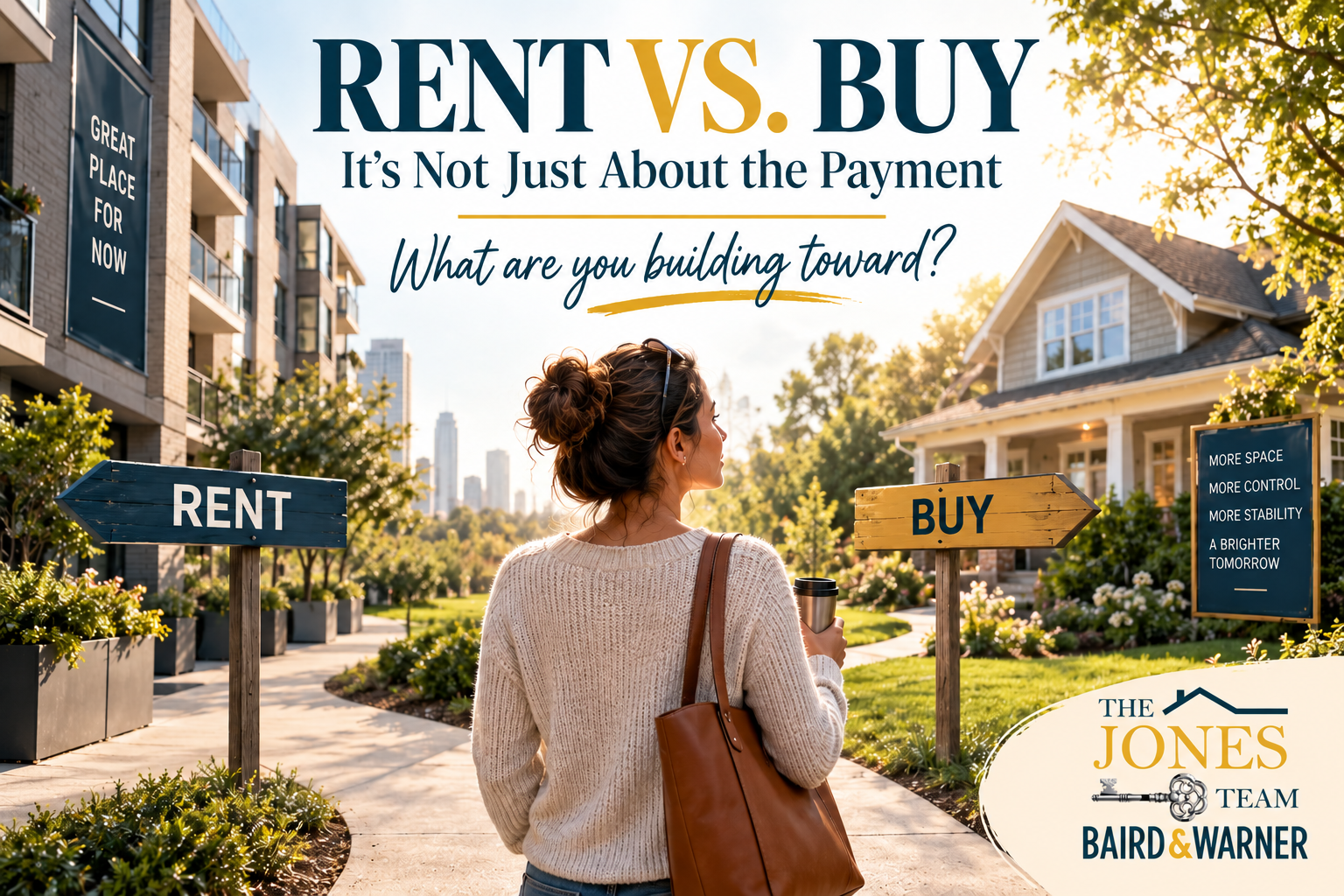
The Short Version
Renting can give you flexibility, fewer maintenance responsibilities and less upfront commitment.
Those are real benefits.
But when you start looking further into the future, homeownership can offer things renting generally cannot:
- ◆Potential equity.
- ◆More control over your space.
- ◆Greater housing stability.
- ◆A fixed principal-and-interest payment with a fixed-rate mortgage.
- ◆The opportunity to create something that is actually yours.
That doesn’t mean everyone should buy a house immediately.
It means that if homeownership fits the life you’re trying to build, it may be worth planning for sooner than you think.
So before you start worrying about when you might buy:
Know your WHY before you worry about your WHEN.
You’ve probably seen some version of this argument online:
“If you’re paying $2,200 in rent, you could be paying $2,200 toward a mortgage!”
And apparently that settles it.
Pack your belongings. Call a lender. Buy a house by Thursday.
Except...not so fast.
If you’ve been following our Future Homeowner Plan, we’ve already knocked down a few assumptions that may have made buying a home feel completely out of reach.
- ◆Your rent may actually be able to help your credit.
- ◆You probably don’t need 20% down.
- ◆And there isn’t one magical credit score separating homeowners from the rest of civilization.
So maybe you’re starting to think:
“Okay. Maybe I actually COULD buy a home someday.”
Good.
Now I want you to ask something completely different:
Should you?
Because qualifying to buy a home and deciding that homeownership makes sense for your life are two very different things.
And while renting can absolutely make sense for a season, owning can offer some pretty powerful long-term advantages that renting simply can’t.
Renting Can Make Sense — Especially for a Season
Yes, I’m a REALTOR® telling you that renting can sometimes be the right decision.
Nobody alert the authorities.
- ◆Maybe you expect to move soon.
- ◆Maybe your job situation is changing.
- ◆Maybe you’re rebuilding financially.
- ◆Maybe you’re not sure where you want to settle.
- ◆Maybe your current priority is flexibility.
In those situations, renting can make plenty of sense.
Fannie Mae specifically identifies short-term flexibility and fewer repair and maintenance responsibilities as benefits of renting.
But here’s the distinction I want you to notice:
Renting can be a good short-term solution without necessarily being the best long-term strategy.
A lot of renters aren’t continuing to rent because they sat down, analyzed their future and decided renting was their strongest long-term financial move.
They’re renting because...
- ◆Buying feels impossible.
- ◆They think they need 20% down.
- ◆They think their credit isn’t good enough.
- ◆They think they’re years away from being able to qualify.
- ◆Or nobody has ever actually helped them figure it out.
And that is a very different situation.
Because once homeownership becomes realistically possible, the comparison starts to change.
Owning Gives You More Than a Place to Live
When you rent, your monthly payment gives you somewhere to live.
That matters.
But at the end of your lease, you don’t own a portion of the property because you paid rent faithfully for twelve months.
Homeownership creates a different opportunity.
You may build equity.
Home equity is essentially the difference between what your home is worth and what you still owe on it.
As you pay down your mortgage—and depending on what happens with the value of your home—you may build equity over time. Freddie Mac identifies building equity as one of the primary potential advantages of ownership.
That does not mean home values are guaranteed to rise.
They aren’t.
It means your monthly housing payment may be doing something rent generally does not:
Helping increase your ownership stake in an asset.
That is a pretty meaningful difference.
You Get More Control Over Your Home
Want to paint?Renovate?Replace the cabinets?Plant a garden?Fence the yard?
Turn the spare room into a legitimate home office instead of a beige room containing one lonely treadmill and fourteen Amazon boxes?
Ownership gives you considerably more control over the property, subject of course to local rules, permits and any applicable homeowners association restrictions.
Freddie Mac specifically includes the freedom to make decisions and changes to your property among the benefits of homeownership.
And that control matters more to some people than they initially realize.
Because eventually, you may get tired of asking permission to make the place you live actually work for the way you live.
You Gain More Housing Stability
Renting comes with a lease.
And leases end.
That can mean renewals, changing rent amounts, new lease terms—or, depending on the situation, an owner who decides they no longer want to rent the property at all.
When you own, you generally control how long you stay.
You’re not renewing permission to live there every year.
For someone who wants to put down roots, stay in a community, keep kids in the same schools, or simply stop moving every few years, that stability can be a major advantage.
Fannie Mae describes homeownership as offering potential long-term consistency, while Freddie Mac highlights the autonomy that comes with owning your home.
But Let’s Talk About the Payment
Because this is where the rent-versus-buy argument tends to get wildly oversimplified.
Suppose you’re paying:
$2,200 per month in rent.
Someone tells you:
“You could have a $2,200 mortgage instead!”
Sounds fabulous.
Except your mortgage payment doesn’t get lonely.
It brings friends.
The cost of owning a home may include:
The friends your payment brings
Principal and interestProperty taxesHomeowners insuranceMortgage insurance, when applicableHOA or condo fees, when applicableUtilitiesMaintenanceRepairsFannie Mae includes taxes, insurance, association fees, mortgage insurance, utilities and property maintenance among the ongoing costs buyers should consider.
So no, I am never going to tell you:
“If your rent is $2,200, you should buy because a mortgage is $2,200!”
That is not enough information.
We need to compare the whole housing picture.
But there’s another part of that comparison that matters just as much.
Today’s Payment Isn’t the Only Payment That Matters
This is the piece that gets left out surprisingly often.
When renters compare buying to renting, they naturally look at:
What am I paying right now?
Makes sense.
But housing isn’t usually a one-month decision.
So let’s ask another question:
What could your housing costs look like five, ten or fifteen years from now?
Your rent is generally fixed for the term of your lease. Fannie Mae specifically describes rental costs as fixed for the lease term.
Then the lease ends.
And your next lease may come with a different number.
That doesn’t mean rent increases every single year or that every rental market behaves the same way.
But your current rent should not automatically be treated as your permanent housing cost.
A fixed-rate mortgage works differently.
With a fixed-rate mortgage, your interest rate stays the same for the life of the loan, and your principal-and-interest payment remains the same. Freddie Mac confirms that your total monthly payment can still change because property taxes and homeowners insurance may change.
That distinction matters.
We’re not saying:
“Buy a house and your housing costs can never increase.”
They can.
- ◆Taxes change.
- ◆Insurance changes.
- ◆Maintenance happens.
- ◆Things break.
- ◆Homes occasionally develop very expensive opinions.
But the principal-and-interest portion of a fixed-rate mortgage isn’t being renegotiated at every lease renewal.
And over a longer timeline?
That can be a pretty big advantage.
Let’s Look at a Realistic Example
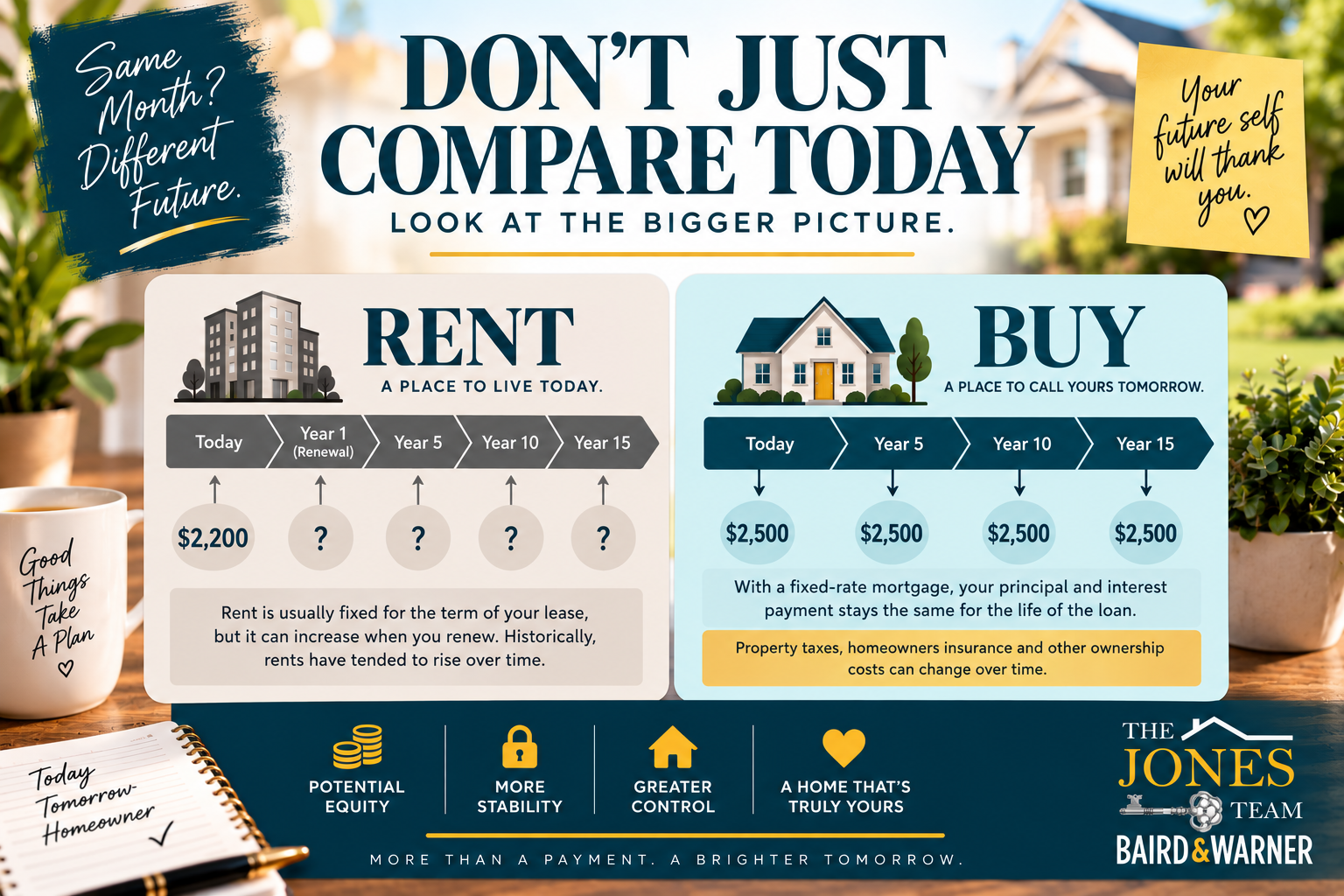
Suppose you’re currently paying:
$2,200 per month to rent.
And after looking at the actual numbers—not the adorable pretend math from social media—you discover that owning a home that works for you might cost closer to:
$2,500 per month.
$2,200
per month to rent
Fixed for the lease term. Then the lease ends.
$2,500
per month to own
Principal & interest fixed for the life of the loan. Taxes and insurance can change.
Today’s numbers. Now ask what they look like in year five.
Your immediate reaction might be:
“Why would I pay $300 MORE?”
Excellent question.
Seriously.
You should ask that.
But don’t stop there.
Ask:
- ◆Will my rent still be $2,200 five years from now?
- ◆How long do I expect to stay in this area?
- ◆What portion of my ownership payment would remain fixed?
- ◆Would I be building equity?
- ◆Would owning give me more space, control or stability?
- ◆Would I still prefer renting if my rent continued increasing over time?
Suddenly we’re no longer comparing:
$2,200 vs. $2,500.
We’re comparing:
What costs less today vs. what may give me more over time.
And THAT is a much better rent-versus-buy conversation.
Because yes, owning might cost a little more today.
But you also need to ask:
What am I getting for that difference?
What Can Homeownership Do That Renting Usually Can’t?
This is where I want you to forget mortgage calculators for a minute.
Most people don’t dream about becoming homeowners because they have a deep emotional attachment to amortization schedules.
You probably want something.
Maybe it’s:
- ◆A fenced yard for your dog.
- ◆More room for your kids.
- ◆A garage.
- ◆A garden.
- ◆A real home office.
- ◆Privacy.
- ◆A neighborhood where you want to stay.
- ◆The freedom to renovate.
- ◆The ability to own pets without negotiating with a landlord.
- ◆The ability to put down roots.
- ◆More control over your future housing.
- ◆The opportunity to build equity.
Or maybe you just want to paint the dining room dark green without submitting a written request in triplicate.
Whatever.
Your reason doesn’t have to sound financially sophisticated.
It needs to matter to you.
What Do You Want Homeownership to DO for You?
Before asking:
“Can I afford to buy?”
I want you to ask:
“What would owning make possible for me?”
- ◆Maybe it would give your family more space.
- ◆Maybe it would give you stability.
- ◆Maybe you’d like more control over where and how you live.
- ◆Maybe you want the potential to build equity instead of continuing to rent indefinitely.
- ◆Maybe you’re tired of lease renewals.
- ◆Maybe you want something that feels like yours.
Once you know the answer, homeownership stops being some vague thing you’re “supposed” to do someday.
It becomes connected to an actual goal.
And goals?
Those we can make plans for.
Where People Get Tripped Up
“Renting is throwing money away.”
Not exactly.
Rent pays for housing.
And sometimes the flexibility that comes with renting is exactly what someone needs.
But unlike ownership, rent generally does not build an ownership interest in the property.
That’s an important distinction when you’re looking at the long term.
“Renting is cheaper.”
Maybe today.
Maybe not.
And today’s payment doesn’t automatically tell you which option will be more beneficial over the years ahead.
You have to look at the whole picture.
“Owning has more expenses, so it must be worse.”
Owning does come with more responsibility.
There are repairs. Maintenance. Taxes. Insurance.
But those costs also come with something renters generally don’t have: ownership, control, stability and the potential to build equity.
So we’re not just asking: “What does it cost?”
We’re asking: “What do I receive in return?”
“If I don’t plan to buy right now, I don’t need to think about it yet.”
This one keeps people stuck.
You don’t need to be ready today to start preparing.
Actually, starting before you’re ready is kind of the whole point.
If you wait until the day you desperately want to buy a house to find out that your credit needs work, your savings need work or you misunderstood the entire financing process...
well.
That’s less of a plan and more of an unpleasant surprise party.
“If I qualify for a mortgage, I should buy.”
Also no.
Homeownership should make sense for your finances and your life.
But if those pieces line up?
Buying can offer long-term advantages that renting simply can’t.
What This Doesn’t Mean
This article is not secretly saying:
- ✗BUY A HOUSE IMMEDIATELY.
Maybe renting still makes sense for you right now.
That’s fine.
The distinction I care about is this:
“I’m renting because it works best for my life right now.”
is very different from:
“I’m renting because I assumed buying was impossible.”
That second one?
That’s what the Future Homeowner Plan is designed to fix.
You don’t have to buy this year.
Maybe your goal is two years away.
Maybe it’s four.
But if homeownership would give you something you really want, knowing that now gives you time to prepare.
And time is one of the best advantages a future homeowner can have.
We’re keeping this month ridiculously simple.
Don’t call a lender.
Don’t start touring houses.
And for the love of Zillow, do not spend tonight emotionally moving into 47 homes you’re not buying.
Your assignment:
Finish this sentence.
“Someday, owning a home would let me ______.”
Maybe:
...build equity....have a yard for my dog....give my kids more space....stop worrying about lease renewals....put down roots....have more control over where I live....create something that’s actually mine.
Write down whatever comes to mind first.
That’s your WHY.
And once you know your why?
The question starts changing from:
“Could I ever buy?”
to:
“What would I need to do to get there?”
And THAT is where things start getting interesting.
Time required: approximately 30 seconds.

Know Your WHY Before You Worry About Your WHEN
You don’t need to buy tomorrow.
You don’t need to know your future purchase price.
You don’t even need to know exactly where you want to live yet.
But if homeownership would give you something you want that renting can’t?
It may be worth making a plan.

That’s what the Future Homeowner Plan is about.
Not pressure.Not artificial urgency.Preparation.
Because “someday” gets a whole lot more useful when it comes with a plan.

When you’re ready to figure out what buying could realistically look like for your life, your timeline and your finances, the Jones Team is here to help you map it out.
No pressure.
No assumptions.
Just a smarter path from:
“I’m renting.”
to
“I’m ready.”
Explore the Future Homeowner Plan →Frequently Asked Questions
Is buying a home better than renting long-term?
For many people who expect to stay in one area and are financially prepared, buying can offer long-term advantages including potential equity, more control over the property, greater housing stability and a fixed principal-and-interest payment when using a fixed-rate mortgage. Renting may still make more sense when short-term flexibility is a priority. Freddie Mac recommends considering finances, future plans and lifestyle when deciding between the two.
Is renting really throwing money away?
No. Rent pays for housing and can provide useful flexibility. However, renters generally do not build an ownership interest in the property through their monthly payments, while homeowners may build equity over time.
Does rent go up over time?
Rent is generally fixed for the term of a lease, but it can change when the lease renews. How much and how often depends on the property, landlord, lease terms and local rental market.
Does a mortgage payment stay the same?
With a fixed-rate mortgage, the principal-and-interest payment stays the same for the life of the loan. The total monthly payment can still change because property taxes and homeowners insurance may change over time.
What are the biggest advantages of buying a home?
Potential advantages include building equity, gaining greater control over your property, more housing stability, freedom to customize your home and the stability of a fixed principal-and-interest payment with a fixed-rate mortgage.
Should I buy if owning would cost more than my rent today?
Maybe. A higher cost today doesn’t automatically make buying a bad decision. Consider how long you expect to stay, what future rent might look like, the additional costs of ownership, potential equity and whether the lifestyle benefits of owning matter to you.
When should I start preparing to buy?
Before you urgently need to. If buying is something you think you may want in the future, starting early gives you more time to understand your credit, savings, financing options and what a realistic timeline might look like.
Keep Going With the Future Homeowner Plan
Still wondering what may be standing between you and homeownership?
Read:
◆Article 1: Your Rent Could Actually Help Your Credit
◆Article 2: WAIT. WHO TOLD YOU THAT YOU NEED 20% DOWN?
◆Article 3: What Credit Score Do You REALLY Need?
Each one tackles another piece of the giant, messy “Can I actually buy a home?” question—without expecting you to become a mortgage expert overnight.
Educational Disclaimer: This article is provided for general educational purposes only and is not financial, tax, legal or mortgage advice. Mortgage programs, qualification requirements, interest rates, property taxes, insurance costs, rents, home values and other housing expenses vary by borrower, property, lender and location. Homeownership does not guarantee appreciation, equity growth or financial gain. Consult appropriately licensed professionals for advice specific to your circumstances.
About The Jones Team
The Jones Team Realtors at Baird & Warner helps buyers and sellers throughout Chicago’s Fox River Valley and northwest suburbs make smarter real estate decisions with education first and pressure somewhere around absolutely not.
Led by Jenny Jones, a REALTOR® with more than 20 years of real estate experience, the team believes people make better real estate decisions when they actually understand their options.
The Future Homeowner Plan was created specifically for renters who may want to own someday but aren’t sure what needs to happen between: “I’m renting.” and “I’m ready.”
Because hoping it magically works out later is not technically a plan.
Sources
- Fannie Mae — Rent vs. Buy: What’s Right for You?
- Freddie Mac — Rent or Buy: Which Option Is Right for You?
- Freddie Mac — Finding the Right Loan
- Freddie Mac — Understanding Common Types of Mortgage Loans
- Freddie Mac — Rent vs. Buy Calculator
Last Reviewed: September 8, 2026 | Next factual review: March 2027
Categories
Recent Posts






It's EASIER to Move When The Jones Team Has Your Back!
+1(224) 622-3237 | jones.team@bairdwarner.com