
The Tollway Wants More of Your Money — Here's What NW Suburb Commuters Need to Know
The Tollway Wants More of Your Money — Here's What NW Suburb Commuters Need to Know
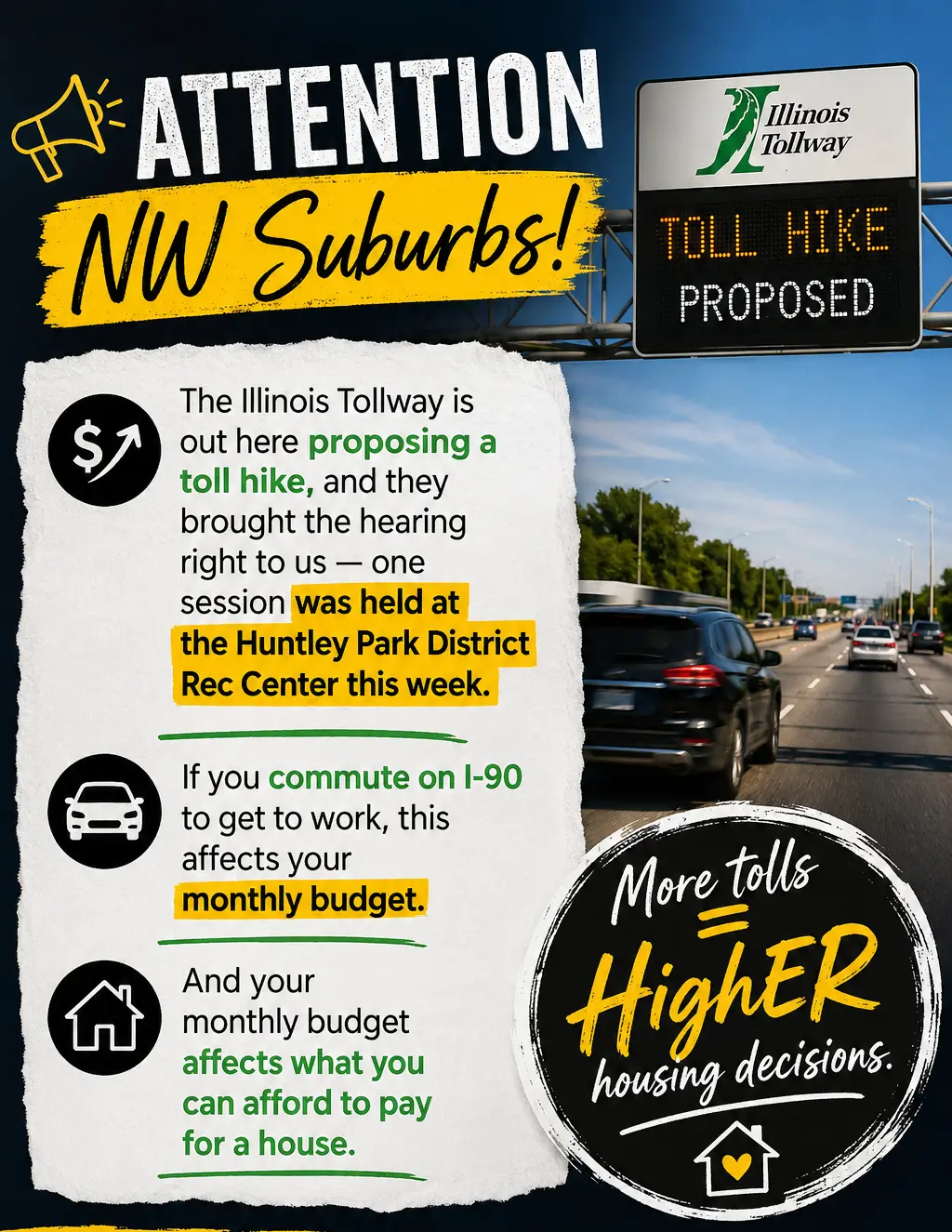
The Illinois Tollway is out here proposing a toll hike, and they brought the hearing right to us — one session was held at the Huntley Park District Rec Center this week. If you commute on I-90 to get to work, this affects your monthly budget. And your monthly budget affects what you can afford to pay for a house. Funny how that works.
Here's the setup: the Illinois Tollway is holding a series of public hearings across the region on proposed toll increases, and residents are showing up to weigh in. The Huntley hearing ran from 6 to 8 p.m., and the comment period stays open for about ten more days if you want to make your opinion officially known (and I'd encourage you to — that's how these things get shaped). Reaction from residents has been, predictably, mixed. Some see it as necessary funding for road and traffic improvements across the Chicago area. Others see it as yet another line item creeping up on a household budget that's already stretched.
Why a toll hike is a housing conversation, not just a commuting one
I know it doesn't look like a real estate story at first glance. But stick with me. Anyone who's shopped for a home out here in the last few years has run the math on I-90 access — it's a genuine selling point for towns like Huntley, Algonquin, and Carpentersville, because it makes a Chicago commute survivable. When the toll cost of that access goes up, it doesn't kill the value of that access, but it does nudge the math for buyers who are stretching their budget between a house payment and a commute. It's one more number in the spreadsheet that families run before they decide which suburb — and which price point — makes sense for them.
What this means for you
If you're already living out here and using the Tollway daily, this is worth a few minutes to submit a comment before the window closes — public hearings only matter if the public actually shows up in the record. If you're weighing a move to the NW suburbs and factoring in a Chicago commute, build a little cushion into your transportation cost assumptions. It won't change whether you should buy out here. It just means the "what does this house actually cost me monthly" conversation needs one more line item.
Toll hikes are never fun to talk about, but pretending they don't affect your housing budget is how people end up house-poor. I'd rather you know now.
· ABC7 Chicago — Residents react to proposed toll increases on Illinois Tollway
· Senator Craig Wilcox's Capitol Report — IL Tollway Hosting Public Hearing on Proposed Toll Hike in Huntley
Loved this? Share it.
Someone on your commute needs to see this before the comment window closes.
--- POST: Is the Chicago Housing Market Actually Cooling Off? A Realist's Read
Is the Chicago Housing Market Actually Cooling Off? A Realist's Read
Two stories crossed my desk this week that seem unrelated but are actually the same story wearing different outfits: is the Chicago housing market cooling off for summer, and why does it feel like nobody can get anything new built anyway? Let's untangle both.
First, the cooling question. Every July, someone asks whether the market is "finally" slowing down, as if a housing market operates on the same rhythm as a heat wave. The honest answer: yes, activity always eases some in mid-to-late summer — that's seasonal, not a signal of collapse. Buyer fatigue sets in, sellers who wanted top dollar in April have mostly already listed, and the back-to-school calendar starts pulling family attention elsewhere. If you're watching Zillow and panicking that the market is "turning," take a breath. This happens every single year.
The bigger story: it's not that demand is falling, it's that supply can't keep up
Here's the part that doesn't get enough attention. While everyone debates whether demand is softening, there's a quieter problem strangling the market from the other direction: new housing supply keeps getting tied up in litigation and process delays. A recent op-ed pointed to a redevelopment fight in River Forest as a textbook case — a site that could add housing is instead stuck in court, while the region's housing shortage doesn't pause to wait for a verdict. Meanwhile, in Chicago proper, projects like a 40-unit apartment building proposed for a vacant Logan Square lot are exactly the kind of infill development that needs to get built faster, not slower, if the region wants any hope of easing price pressure.
This isn't just a city problem. Every NW suburb I work in has some version of this same tension — a parcel that could be housing, a process that takes years, and neighbors on both sides of the fight with legitimate points. The pattern is the same everywhere: it is almost always easier to block new housing than to build it, and that asymmetry is a big part of why prices in this region haven't corrected the way some buyers keep hoping they will.
What this means for you
If you're a buyer waiting for a "cooling market" to hand you a discount: seasonal slowdowns are real, but they're not the same thing as a supply-and-demand reset. The structural shortage isn't going anywhere fast. If you're a seller: don't let July jitters talk you into panic pricing — the fundamentals underneath this market are still tight, even when the pace slows down for a few months.
Twenty years of watching this cycle repeat itself has taught me one thing: "the market is cooling" and "the market has a supply problem" can both be true at the same time. Don't let anyone sell you a simpler story than that.
· Crain's Chicago Business — Judicial delays worsen Illinois housing crisis (Op-Ed)
· Block Club Chicago — 40 Apartments, Including Rental Townhomes, Pitched For Vacant Logan Square Lot
Loved this? Share it.
Send this to someone waiting on a "market crash" that isn't coming.
--- POST: Illinois REALTORS® Is Watching a Federal Housing Bill Closely — So Am I
Illinois REALTORS® Is Watching a Federal Housing Bill Closely — So Am I
Illinois REALTORS® put out an official response this week to a federal housing bill making its way through Congress. The full details are still shaking out, but when the state's largest real estate trade association issues a formal statement, it's worth a note on your radar.
According to CEO Jeff Baker's response, the organization is actively evaluating how the legislation could reshape things for buyers, sellers, and agents across the state — Baker specifically flagged questions about how the bill could change the landscape for the industry going forward. I don't have the full text of the bill in front of me yet, and I'm not going to pretend I do. What I do know is that when Illinois REALTORS® feels the need to respond publicly and quickly, it's usually because the bill touches something that actually matters to your transaction — financing rules, tax treatment, commission structures, or fair housing provisions are the usual suspects.
Why I'm not speculating yet
I've been doing this long enough to know that federal housing bills get amended, watered down, or quietly shelved more often than they become law as originally written. Jumping to conclusions about "what this means for you" before the bill has even cleared committee is how you end up spreading a rumor instead of information. So consider this your heads-up, not your analysis. When more specifics land, I'll break it down properly.
What this means for you
If you're mid-transaction right now, nothing changes today — current rules apply until something is actually signed into law. If you're planning a purchase or sale later this year, it's worth keeping half an eye on this story, because federal housing policy shifts have a way of trickling down into local financing and closing costs faster than people expect.
I'll keep tracking this one and let you know the second there's something concrete to react to instead of just react-worthy.
· Capitol Fax — Your Illinois News Radar: Illinois REALTORS® response on Federal housing bill
Loved this? Share it.
Know someone who should keep an eye on this bill? Pass it along.
--- POST: Home Hacks You'll Actually Use (Not Just Pin and Forget)
Home Hacks You'll Actually Use (Not Just Pin and Forget)
Your feed is full of "life hacks" that require buying six products and a Saturday you don't have. This roundup skips that. These are the low-effort, high-payoff kind — the ones that survive past week one.
A new batch of practical home hacks is making the rounds, and unlike a lot of what gets served up under that label, this stuff is actually usable on a Tuesday night with what's already in your cabinet.
The cleaning tricks worth stealing
The consistent theme across this round of hacks: stop reaching for specialty products when a basic combination already does the job. Dryer sheets, it turns out, are shockingly good at cutting through baseboard dust and grime — wipe once, and the anti-static coating keeps dust from resettling for days. White vinegar and a microfiber cloth still beat most glass cleaners for streak-free windows and mirrors, and it costs a fraction as much. And the classic: a lemon half dropped down the garbage disposal with the water running does more for kitchen odor than any spray you'll buy.
The time-savers that stick
The best hacks aren't the clever ones — they're the ones that reduce future effort with almost no setup cost today. A few worth adopting: keep a small caddy of your most-used cleaning supplies and carry it room to room instead of storing everything under one sink and walking back and forth. Do a five-minute "reset" each night — dishes away, surfaces cleared — instead of letting Saturday become a four-hour catch-up project. And set a recurring reminder to swap HVAC filters; it's the single most-skipped maintenance task in most homes, and it quietly costs you in energy bills and air quality.
None of this is glamorous. That's kind of the point — the hacks that actually survive contact with real life are boring, repeatable, and don't require a trip to the store.
Why this matters if you're getting ready to sell
A house that's maintained with these small, boring habits shows completely differently than one that gets a frantic deep clean the week before listing photos. Buyers notice the difference between "recently cleaned" and "consistently cared for" even if they can't articulate why. Consistent upkeep is the cheapest staging tool you'll ever have.
Pick two of these and actually do them for a month. That's the whole strategy. No bins required.
Loved this? Share it.
Send this to whoever in your life still owns a Snuggie's worth of unused cleaning gadgets.
Categories

It's EASIER to Move When The Jones Team Has Your Back!
+1(224) 622-3237 | jones.team@bairdwarner.com